Overview / Value Proposition
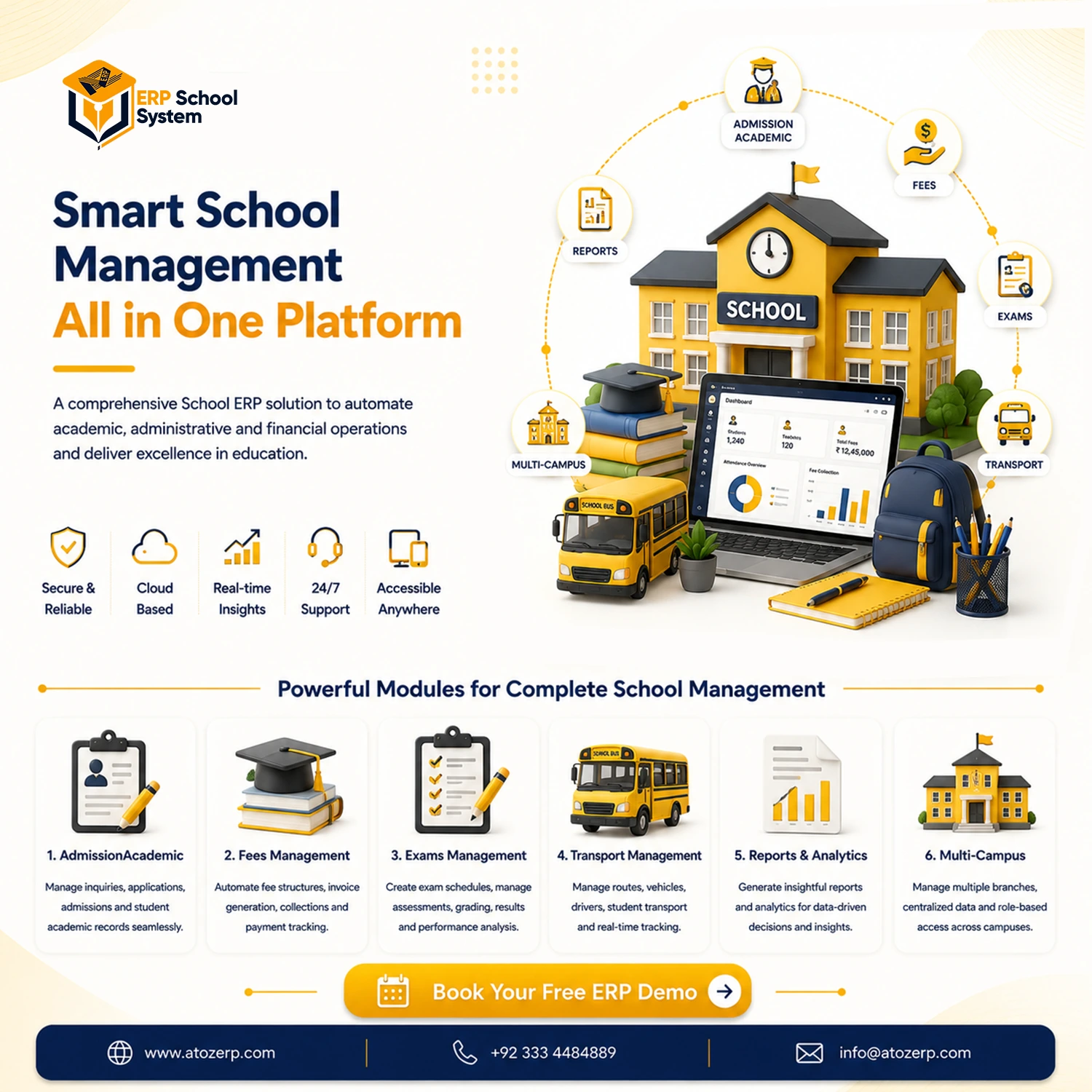
ATOZ School Management ERP is built for schools that need operational consistency across academics, student records, fees, exams, transport, and reporting. Instead of managing admissions in one register, attendance in another sheet, and fees in disconnected ledgers, your staff can work from one structured platform with role-based control and campus-aware setup. The result is cleaner execution, faster daily decisions, and fewer operational errors when multiple departments coordinate around the same student lifecycle.
The product is especially practical for organizations running more than one campus or planning to scale from one campus to several. Academic years, terms, classes, sections, subjects, rooms, period slots, and timetables are configured centrally and reused in downstream workflows. Teachers are assigned from HR employees, holidays are published once, and daily school operations follow a clear academic structure. This avoids ad-hoc scheduling and reduces routine conflict between academic office and class operations.
On the student side, the flow starts at enquiry and application, then moves to conversion, enrollment, attendance tracking, promotion, and historical continuity. Guardians can be linked to student records, attendance statuses are maintained as Present, Absent, Late, Leave, and Holiday, and institutions can maintain control of the full admission-to-progression journey. This keeps front desk, admission staff, and class administration aligned on the same data.
Fee management combines setup flexibility with operational control for real-world school offices. You can configure fee heads, structures, concessions, invoices, late fee logic, transport invoices, collection workflows, voids, and refunds with receipt printing. This model is designed around clerk-driven offline collection counters. Online and card values are present as method labels, but the core implementation remains office collection focused, which suits many schools transitioning from manual cashbook-style routines.
Examination operations are covered through grade scales, exam and paper definitions, marks entry, seating and admit cards, merit and subject reports, pass-fail reports, and report card outputs. Alongside this, the system includes certificates issue and print, student leave handling, notices, message logs, and transport operations for routes, vehicles, stops, and riders. Leadership teams also get ten campus-required analytics report pages for management, student, attendance, examination, fees, teacher, academic, admission, transport, and campus-level visibility.
Key Features
Academic administration
- Multi-campus setup with academic years and terms
- Class/section, subject, room, and period-slot masters
- Timetable creation with teacher assignment from HR employees
- Holiday configuration aligned with school calendars
Student lifecycle and attendance
- Admission funnel from enquiry to application to conversion
- Student and guardian management with enrollment tracking
- Daily attendance states: Present, Absent, Late, Leave, Holiday
- Class promotion workflows at year-end transitions
Fees, exams, and school operations
- Fee heads, structures, concessions, invoices, late fees, and transport invoices
- Collection desk operations with collect, void, refund, and receipt print
- Grade scales, exam setup, marks, admit cards, and report cards
- Certificates, student leave, notices, and message logs with delivery stubs
- Transport vehicles, routes, stops, and student rider assignment
Business Benefits
First, schools get process standardization that survives staff changes. When onboarding new clerks, coordinators, or section heads, workflows are already structured in the system and do not depend on memory-heavy manual processes. This protects continuity and reduces execution risk during peak windows like new sessions, fee cycles, and exam periods.
Second, financial and academic controls improve because operational records are connected. Fee invoices, attendance trends, exam outcomes, and admissions status can be analyzed through built-in report pages that are already grouped by function. Leadership does not need to ask each department for separate spreadsheets before reviewing performance.
Third, schools can improve parent communication readiness by provisioning portal users from ERP. The ERP handles administration and provisioning, while companion SocialV apps can consume these portal identities for parent and student experiences. This allows institutions to phase digital transformation without forcing all user interfaces into one monolithic module on day one.
Finally, the platform supports growth on the same ATOZ stack. As organizations mature, they can evaluate sibling modules such as Cashbook, Finance, Inventory, HRM, and Gatepass under compatible architecture and planning. This roadmap provides expansion options without requiring an immediate platform switch.
Who It's For / Use Cases
- School groups managing multiple campuses with shared governance
- Single-campus institutions formalizing admission, fees, and exams
- Principals and administrators requiring visible daily analytics
- Fee desks transitioning from manual registers to controlled invoicing
- Academic coordinators balancing timetable, staff assignment, and term planning
- Transport coordinators who need route and rider accountability
Typical use cases include pre-session admissions planning, recurring monthly fee runs, exam cycle execution, year-end promotion, and transport roster management. The platform is also well-suited for schools that require auditable operational records without over-promising advanced integrations that are still on future roadmaps.
How It Works
Implementation usually starts with foundational setup: campuses, academic years, classes, sections, subjects, rooms, periods, and holidays. Once structure is in place, staff configure admissions pipeline stages and student masters, then activate attendance and fee definitions. Because these modules share identifiers and structure, downstream operations remain consistent as data volume grows.
After setup, teams execute routine operations in role-specific workflows. Admission staff process enquiries and applications, academic teams run timetable and teacher assignments, class operations maintain daily attendance, and fee counters collect against generated invoices with clerk-level accountability. Examination teams define grade scales and papers, enter marks, and publish report cards. Management then monitors outcomes through dedicated report pages grouped by organizational function.
For institutions using companion digital channels, portal users are provisioned from ERP and shared with SocialV parent/student experiences. This keeps access control initiated from ERP while allowing user-facing journeys to evolve independently in companion applications.
ATOZ ERP Integration & Advantages
ATOZ School Management ERP operates as a practical core for school administration and works within a broader ATOZ ecosystem. Sibling modules like Cashbook, Finance, Inventory, HRM, and Gatepass are available on the same stack and planning framework, supporting phased operational expansion. Importantly, fee workflows in the current school module do not auto-post to Cashbook by default; organizations should treat those as coordinated but distinct modules until planned integrations are enabled.
The current ERP focuses on institutional control, reporting discipline, and consistent departmental workflows. Future enhancements are clearly separate and should be considered roadmap items: live SMS/WhatsApp gateway delivery, online payment gateway processing, in-ERP parent portal UI, GPS bus tracking, library/hostel/LMS modules, and biometric attendance integration.
Final CTA
If your school wants one dependable operating system for admissions, academics, fees, exams, transport, and reports, ATOZ School Management ERP gives your team the structure to run confidently every day. Request a guided demo focused on your campus model, fee cycle, and reporting priorities so your stakeholders can see practical fit before rollout.